Choose how to use CLEAR.
Assess your relationship independently, or complete the questions separately with your partner and compare your reflections if you both feel safe and willing.
Read a free sample of Before You Marry
Read the excerpt here without signing up. You can also download the sample as a PDF to read later.
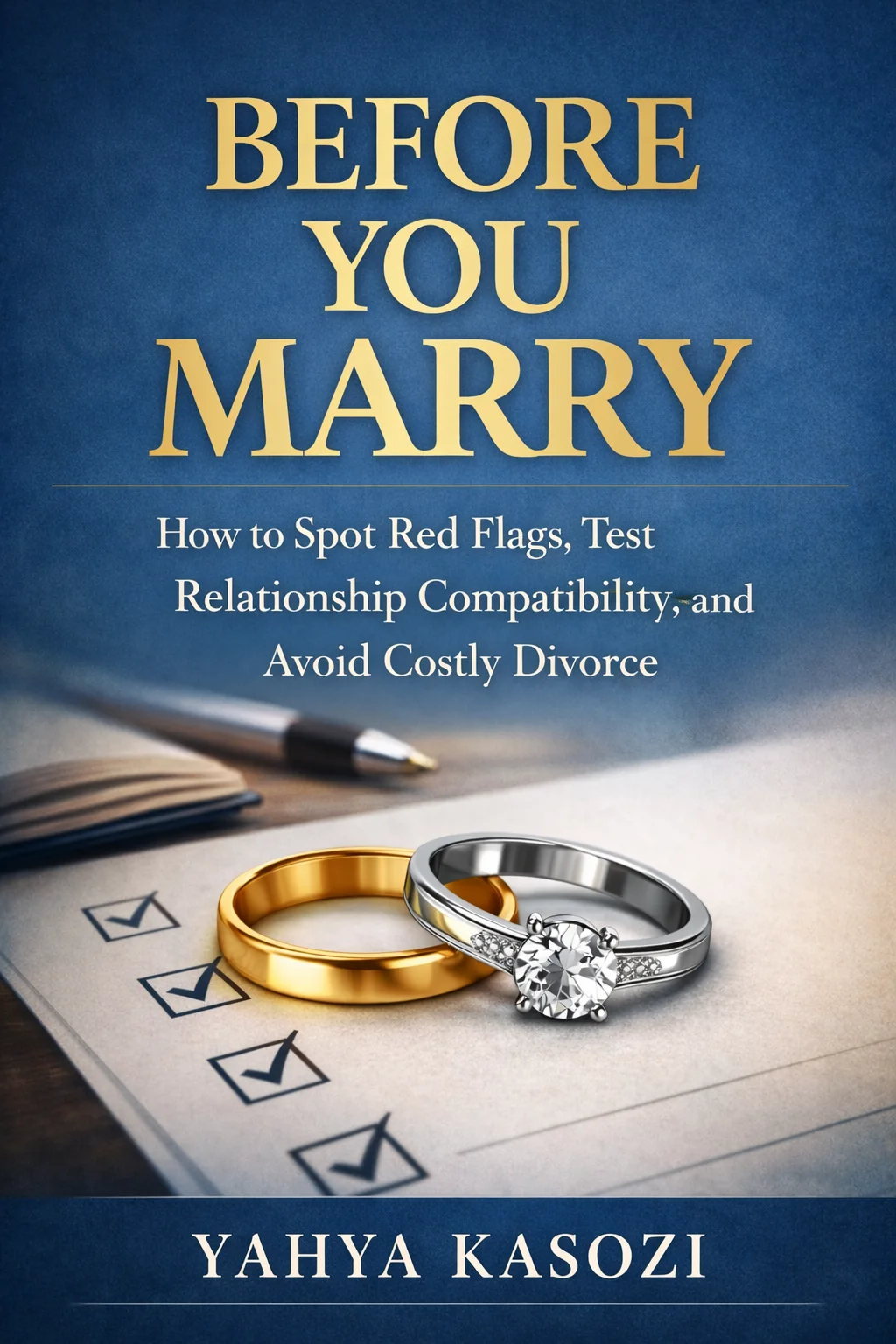
Before You Marry
How to Spot Red Flags, Test Relationship Compatibility, and Avoid Costly Divorce
Yahya Kasozi
Copyright
Copyright © 2026 Yahya Kasozi
All rights reserved.
No part of this publication may be reproduced, distributed, or transmitted in any form or by any means without prior written permission of the author, except for brief quotations used in critical review or scholarly reference.
This book presents a structured pre-commitment evaluation framework that synthesizes established research from personality psychology, longitudinal marital studies, behavioral economics, and conflict science.
It does not constitute medical, legal, financial, or psychological advice. Readers remain solely responsible for their decisions and outcomes.
For updates and additional resources: https://yahyakasozi.com
ISBN: 978-9913-08-385-0
DISCLAIMER
This book is not therapy.
It is not counseling.
It is not a substitute for professional guidance from a licensed expert.
It is a structured decision framework designed to reduce preventable marital instability before commitment.
It does not tell you whom to marry.
It provides measurable criteria for evaluating structural compatibility.
Marriage is a voluntary commitment.
Clarity is your responsibility.
Structural Risk Scan
Pre-Commitment Threshold Check
This assessment is not emotional.
It is structural.
Answer based on repeated observation across time and stress — not optimism.
If any answer is uncertain, structural verification is incomplete.
1. Character Stability (C)
Observed integrity under inconvenience?
Reliability without supervision?
Consistency across environments?
Yes / No / Unverified
2. Emotional Regulation (E)
Conflict handled without contempt, escalation, intimidation, or chronic withdrawal?
Repair clean, without deflection?
Repetition decreasing over time?
Yes / No / Unverified
3. Accountability Patterns (A)
Voluntary ownership?
Behavioral correction measurable?
Reduced repetition sustained across months?
Yes / No / Unverified
4. Life Vision Alignment (L)
Financial philosophy aligned?
Ambition trajectory compatible?
Lifestyle architecture convergent?
Five-year direction stable without identity compression?
Yes / No / Unverified
5. Red Flag Elimination (R)
No active patterns of:
Chronic dishonesty
Contempt
Intimidation
Persistent irresponsibility
Addiction without sustained recovery
Control behaviors
Verified eliminated across time and stress?
Yes / No
Threshold Interpretation
All pillars verified → Structural sufficiency likely.
Any pillar unverified → Delay. Gather data.
Any active red flag → Do not proceed.
Marriage multiplies repeated patterns.
Evaluate structure — not momentum.
PREFACE
Why This Book Exists
Most people do not marry recklessly.
They marry emotionally.
They marry optimistically.
They marry under momentum.
Divorce is statistically common. Chronic dissatisfaction is more common still. Financial cost is visible. Emotional erosion is gradual, but cumulative. Most people do not see the erosion coming.
The problem is rarely a lack of love.
It is a lack of structure.
Marriage is often evaluated with less rigor than a job offer or business partnership — despite carrying far greater long-term consequences.
People ask:
Do we love each other?
Does this feel right?
Are we compatible?
These questions matter.
But they are incomplete.
Long-term stability is not primarily predicted by intensity.
It is predicted by repeated behavior under stress, accountability after failure, and alignment in direction.
This book was written for individuals who understand that commitment is not a romantic milestone.
It is a structural merger.
You will not find reassurance here.
You will find the criteria.
Why CLEAR Exists
Over years of observing recurring patterns in unstable commitments, one pattern became clear: people were not lacking love — they were lacking criteria. CLEAR was developed to convert vague compatibility language into a measurable structural evaluation. It is not a theory. It is a decision architecture designed to reduce preventable regret.
Table of Contents
INTRODUCTION
Marriage Is a Structural Decision
A significant proportion of first marriages end in divorce, with higher rates for subsequent marriages (Gottman, 1994). Behind each statistic is a decision that once felt confident. The issue is evaluation — not intention.
Most people evaluate marriage emotionally.
Few evaluate it structurally.
They ask:
Do we love each other?
Do we feel compatible?
Does this feel right?
These questions are understandable.
They are insufficient.
High-stakes commitments are not evaluated by feeling alone. Engineers stress-test systems before approving structures. Investors perform due diligence before acquisitions. Marriage is more permanent than most business contracts — yet it is often entered with less structural evaluation.
Marriage is not a romantic milestone but a long-term merger between two behavioral systems. Attraction initiates connection. Emotion strengthens attachment. Repeated behavioral patterns under stress determine durability.
Across decades of longitudinal marital research, including the work of psychologist John Gottman, a consistent pattern emerges (Gottman & Levenson, 1999; 2000):
Early emotional intensity predicts short-term satisfaction.
Repeated behavioral patterns under stress predict long-term stability.
The difference between those two is the difference between hope and architecture.
Hope feels powerful. Architecture endures. Marriage requires architecture.
Why Intelligent People Still Choose Poorly
Many thoughtful, disciplined individuals enter unstable marriages. They are not careless. They are not naïve. They are human.
Neuroimaging research on romantic attachment shows that early bonding increases activity in dopaminergic reward pathways associated with motivation and reinforcement, while decreasing activation in regions linked to critical social judgment and threat detection. (Fisher, Aron, & Brown, 2005)
In practical terms:
Bonding narrows scrutiny.
Ambiguity feels promising.
Intensity feels meaningful.
Questioning feels disloyal.
Behavioral economists Daniel Kahneman and Amos Tversky demonstrated that humans systematically distort evaluation under emotional investment — particularly when potential loss is perceived. Loss aversion research shows losses feel approximately twice as powerful as equivalent gains. Once attached, the mind works to preserve the bond.
Cognitive distortions compound:
Confirmation bias favors attachment-supporting data.
Optimism bias overestimates the probability of improvement.
Sunk cost escalation increases justification as investment grows.
Intelligence does not eliminate distortion.
It refines the explanation.
You do not ignore warning signs.
You reinterpret them.
Hope is natural. It is not a decision system.
The Structural Compatibility Question
The central question of this book is not:
“Do we feel strongly about each other?”
It is:
“Does this relationship meet the structural safety threshold for lifelong commitment?”
Marriage is a compounding system. Small patterns, repeated weekly, become structural realities.
Mild defensiveness becomes chronic exhaustion under sustained stress.
Minor financial disorganization becomes instability under shared responsibility.
Small ambition divergence becomes long-term resentment.
Marriage magnifies repetition because repetition compounds.
Marriage does not fail at its strongest moment. It fails at its most repeated weakness.
Structural compatibility isolates predictive variables repeatedly supported across research domains:
Integrity under inconvenience
Shared long-term direction
Emotional regulation under stress
Internalized accountability
Absence of persistent disqualifying red flags
These are observable over time and are associated with long-term relational stability (Gottman & Levenson, 2000).
Emotional Blending vs Dimensional Evaluation
Without defined criteria, most people evaluate relationships holistically:
“If it feels mostly good, it is mostly stable.”
In complex systems, global impressions increase error. Dimensional evaluation reduces it.
Charm softens financial concern.
Chemistry softens volatility.
Affection softens irresponsibility.
Strength in one domain masks weakness in another.
Marriage does not fail because it is “mostly strong.”
It fails at its weakest structural point.
Each core dimension must meet the minimum threshold independently.
What This Book Introduces
This book introduces the CLEAR Structural Compatibility Framework — a dimensional model for evaluating marriage decisions before commitment.
It synthesizes converging research across:
Longitudinal marital stability studies
Personality trait stability research
Conflict and repair science
Attachment theory
Behavioral decision theory
Value congruence findings
No single theory predicts marital durability alone. But certain structural domains consistently reappear across decades of data.
The goal is not to eliminate uncertainty.
It is to eliminate avoidable instability.
You cannot predict everything.
You can measure what repeatedly predicts the outcome.
What This Book Is Not
This is not therapy.
It is not counseling.
It is not romantic reassurance.
It does not tell you whom to marry.
It provides criteria.
Marriage should not be entered into because momentum carried you there. It should be entered because the structure supports it.
The Standard
Before committing to a business partner, people review contracts. Before purchasing property, they inspect foundations.
Marriage deserves equal seriousness and rigor.
If emotional certainty contradicts structural evidence, structure must win — not because love is unimportant, but because love without stability erodes.
Marriages rarely explode. They erode — one tolerated pattern at a time.
Gradual erosion becomes chronic strain.
Chronic strain becomes regret.
The Required Shift
Replace:
“I feel confident.”
With:
“I have verified consistency across time and stress.”
Replace:
“It seems fine.”
With:
“It meets the structural threshold.”
Replace:
“We’ll figure it out.”
With:
“We have observed reliable performance under pressure.”
Marriage is a structural decision — and structural decisions require structure.
Chapter 1: The Intelligence Illusion
Daniel considered himself disciplined.
He evaluated investments carefully.
He compared career opportunities analytically.
He read contracts before signing them.
When he met Alina, that structure quietly dissolved.
The attraction felt immediate.
Conversations flowed effortlessly.
Conflict was minimal.
The future felt obvious.
He did not feel impulsive.
He felt certain.
Two years into marriage, repetition replaced certainty.
Financial disagreements intensified under pressure.
Arguments escalated faster than expected.
Apologies occurred — behavioral change lagged.
Nothing catastrophic.
Just repetition.
Repetition becomes structure.
Intelligence Does Not Neutralize Bias
A persistent myth suggests intelligent people are less likely to choose poorly.
Research suggests something narrower.
Intelligence increases reasoning capacity.
It does not eliminate attachment bias.
Neuroimaging studies of romantic attachment show heightened activity in dopaminergic reward systems during bonding phases — increasing motivation and focus on the partner — while regions associated with critical social evaluation show reduced activation (Fisher, Aron, & Brown, 2005).
Scrutiny narrows.
Behavioral economists Daniel Kahneman and Amos Tversky demonstrated that emotional investment systematically distorts risk assessment, particularly under perceived loss. Loss aversion research shows that potential losses feel approximately twice as psychologically powerful as equivalent gains (Kahneman & Tversky, 1979; Tversky & Kahneman, 1991). Once attached, the mind works to preserve the bond.
Confirmation bias strengthens.
Optimism bias expands.
Commitment escalation deepens.
You do not overlook instability.
You reinterpret it.
Dismissiveness becomes stress.
Financial vagueness becomes temporary.
Escalation becomes passion.
Intelligence explains instability.
Structure prevents it.
Rationalization reduces discomfort. It does not reduce risk.
The Rationalization Mechanism
Case Study: The Manageable Pattern
Davis described his fiancée as “intense but passionate.”
During disagreements, her tone sharpened quickly. Apologies followed.
Nothing extreme.
Nothing abusive.
Just escalation — weekly.
Before marriage, he explained it:
“She cares deeply.”
“She’s just expressive.”
Three years later, he began editing his words before speaking.
By year five, difficult topics required preparation.
By year seven, silence replaced spontaneity.
Nothing catastrophic happened.
Repetition did.
Consider a repeated pattern:
Dismissive tone during disagreement
Defensive reactions when corrected
Financial ambiguity under pressure
Individually, each incident appears manageable.
The analytical mind supplies context:
“They’re stressed.”
“It’s an adjustment period.”
“No one is perfect.”
Isolated explanations may be reasonable.
Marriage is not built on isolated events.
It is built on recurring patterns.
When a behavior persists across contexts and months, explanation no longer neutralizes risk.
Reducing dissonance is not the same as increasing stability.
Emotional Certainty vs Structural Verification
Emotional certainty feels powerful — and misleading.
You feel understood.
You feel chosen.
You feel aligned.
These experiences are real.
They are not predictive.
Longitudinal marital research consistently finds that early satisfaction predicts short-term happiness, while conflict regulation patterns under stress predict long-term outcomes.
Emotions reflect internal experience.
Structural compatibility predicts external trajectory.
A relationship can feel intense while containing:
Financial philosophy divergence
Escalation under stress
Weak accountability
Inconsistent integrity
Directional misalignment
Intensity masks instability because activation feels like depth.
Structure exposes instability because repetition reveals a pattern.
If intensity declined tomorrow, would stability remain?
That question separates attachment from architecture.
The Confidence Trap
Intelligent individuals often assume:
“I read people well.”
“I would know if something were wrong.”
“My intuition is strong.”
Confidence without criteria produces reactive evaluation.
Judgment becomes influenced by:
The last conversation
The current emotional climate
Recent repair attempts
Short-term reassurance
Short-term emotional weather does not forecast long-term stability.
Structural evaluation requires dimensional analysis — not global feeling.
Not:
“Does this feel good?”
But:
“How does this perform across domains under stress and over time?”
Pattern Recognition Over Emotion
Research across personality science and stress-response studies converges on a consistent principle:
Stress amplifies baseline tendencies. It does not create new ones.
Charm appears early.
Character appears under inconvenience.
Attraction activates quickly.
Accountability reveals slowly.
If defensiveness appears under moderate stress, it intensifies under greater responsibility. If accountability weakens under minor tension, it deteriorates under sustained strain.
Marriage often increases exposure to baseline tendencies.
You do not marry who someone could be.
You marry who they repeatedly are.
The Cost of Overriding Structure
Most people do not marry blindly.
They marry while suppressing data.
They notice subtle misalignment.
They sense early discomfort.
They observe minor inconsistencies.
But the relationship “mostly works.”
Mostly is not structural sufficiency.
Marriage compounds repetition:
Small volatility becomes chronic tension.
Minor defensiveness becomes communication fatigue.
Mild financial inconsistency becomes a long-term strain.
Structural weaknesses rarely explode.
They erode.
Erosion is quiet.
Quiet erosion becomes cumulative instability.
The Structural Reframe
Replace:
“I feel confident.”
With:
“I have observed consistency across time and stress.”
Replace:
“There are no major red flags.”
With:
“Each structural dimension meets minimum safety threshold.”
Replace:
“We love each other.”
With:
“We are structurally compatible.”
Love without structure feels powerful.
Structure without love feels empty.
Sustainable marriage requires both.
But structure must be verified — not assumed.
The Diagnostic Pause
Before proceeding in a serious relationship, ask:
Have I observed this person under sustained stress?
Have patterns repeated across multiple contexts?
Am I explaining behavior more than measuring it?
Would this relationship feel stable if the intensity decreased?
If nothing improved from today forward, would I still commit?
If your confidence depends on transformation rather than observation, pause.
Marriage is not a projection strategy.
It is a structural commitment.
Intelligence alone does not prevent error.
Structure does.
Chapter 2: Attraction Bias and the Neurochemistry of Attachment
Maya described her relationship in one word:
“Electric.”
They talked for hours.
Disagreements felt intense — reconciliation felt even more intense.
The connection felt rare.
She interpreted volatility as depth.
Many people do.
Attraction reorganizes perception.
What Happens During Early Attachment
Early romantic attachment activates dopaminergic reward circuitry — neural systems associated with motivation, reinforcement, and pursuit.
Research in affective neuroscience shows increased activity in reward pathways during early bonding, while regions associated with critical social evaluation and threat detection show reduced activation.
In practical terms:
Focus on the partner increases.
Perceived significance amplifies.
Risk assessment softens.
Oxytocin increases perceived trust before long-term behavioral consistency is verified.
You may feel safe before safety has been demonstrated.
Feeling secure is not stability.
Chemistry Is Not Compatibility
Chemistry measures emotional activation.
Compatibility measures structural alignment.
Chemistry is immediate.
Compatibility is behavioral and longitudinal.
Two people can experience powerful chemistry while diverging in:
Financial philosophy
Conflict regulation
Ambition level
Long-term direction
Accountability patterns
Risk tolerance
During calm seasons, these differences feel complementary.
Under stress, they generate friction.
Longitudinal marital research consistently finds that early intensity predicts short-term satisfaction, while emotional regulation and value alignment predict long-term durability.
Attraction accelerates bonding.
It does not eliminate misalignment.
Intensity creates connection.
Alignment sustains it.
The Intermittent Reinforcement Trap
Behavioral psychologist B.F. Skinner demonstrated that variable reinforcement schedules produce stronger behavioral persistence than predictable reward patterns (Skinner, 1953).
Volatile relationships often operate on this principle:
Conflict → emotional distress → intense reconciliation.
The unpredictability strengthens attachment disproportionately.
The high feels higher because the low preceded it.
This cycle is not evidence of depth.
It is reinforcement.
Intensity is not compatibility.
It is activation.
The Confirmation Bias Amplifier
Once attachment deepens, the mind protects the bond.
Confirmation bias favors evidence that supports a connection.
Optimism bias overestimates improvement.
Sunk cost bias increases justification.
Dismissiveness becomes:
“They didn’t mean it.”
Financial vagueness becomes:
“They’ll improve.”
Escalation becomes:
“That’s just passion.”
Each explanation may be plausible.
Durability is not predicted by explanation.
It is predicted by repeated behavior under stress.
When explanation frequency exceeds pattern reduction, attachment is leading evaluation.
The Acceleration Effect
Rapid bonding often feels like clarity.
“We just knew.”
“It felt different immediately.”
“It happened fast because it was real.”
Speed increases emotional certainty.
It reduces analytical distance.
Stable compatibility tolerates time.
Unstable dynamics resist it.
If slowing down threatens the relationship, instability may already exist.
Structural strength withstands observation.
Volatility Misread as Depth
High emotional intensity is frequently misinterpreted as relational depth.
Escalation followed by dramatic reconciliation creates powerful bonding through intermittent reward cycles.
But intensity and stability are independent variables.
If arguments escalate quickly, repair slowly, and recur frequently, intensity converts into exhaustion.
Longitudinal findings suggest that repeated negative interaction patterns are associated with increased marital dissatisfaction over time (Gottman & Levenson, 2000).
Repetition, not drama, determines trajectory.
Premature Trust
Trust should follow observation.
Instead, it often follows emotion.
Statements such as:
“I just trust them.”
“I know their heart.”
“I can feel they’re genuine.”
may be sincere.
Structural safety requires stress exposure.
Observe behavior under:
Financial pressure
Public correction
Fatigue
Disappointment
Boundary enforcement
Reliability under convenience is easy.
Integrity under inconvenience is diagnostic.
Emotional trust forms quickly.
Structural trust forms slowly.
Marriage requires the latter.
Attachment vs Architecture
The healthy sequence:
Interest → Evaluation → Decision
The common sequence:
Interest → Emotional Investment → Justification → Decision
Once emotional investment deepens, cognitive dissonance reduces perceived risk to preserve attachment.
This is not weakness.
It is wiring.
Without structure, wiring becomes impulsive.
Before progressing toward commitment, ask:
Have I observed this person during genuine stress?
Have patterns repeated across months, not days?
Would stability remain if intensity declined?
Am I mistaking activation for alignment?
Attraction initiates connection.
It must not determine commitment.
Marriage is not sustained by chemistry.
It is sustained by structure.
Chapter 3: Loneliness, Scarcity, and the Fear of Being Alone
Karim did not feel desperate.
He felt behind.
At thirty-two, wedding invitations multiplied.
Engagement announcements increased.
Family members asked subtle questions.
“Any updates?”
Nothing catastrophic changed in his life.
But the psychological environment shifted.
Scarcity entered the equation.
The Scarcity Effect
Behavioral economic research suggests that perceived scarcity can narrow cognitive focus and shift attention toward short-term relief rather than long-term evaluation (Mullainathan & Shafir, 2013). When individuals believe time or opportunity is limited, attention shifts toward immediate relief rather than long-term optimization.
Decision quality may decline under perceived shortage conditions (Mullainathan & Shafir, 2013).
In relationships, scarcity subtly changes the evaluation question:
From:
“Is this structurally compatible?”
To:
“Is this sufficient?”
Sufficiency is not stability.
Choosing someone because they are available is not discernment. It is relief.
Loss Aversion and Timeline Pressure
Daniel Kahneman and Amos Tversky’s Prospect Theory demonstrated that losses feel approximately twice as psychologically powerful as equivalent gains.
When peers marry and timelines advance, perceived “falling behind” feels like loss — even if nothing objective has changed.
Under timeline pressure:
Standards erode gradually.
Evaluation windows shorten.
Red flags soften into “normal flaws.”
The anticipated pain of being alone feels greater than the long-term cost of misalignment.
Loss aversion distorts evaluation.
Relief Is Not Compatibility
Case study: The Timeline Decision
Sara felt behind.
Most of her friends were engaged. Her family asked questions weekly.
When she met Imran, he was stable, kind, and available.
There were small incompatibilities in long-term vision — travel, ambition, lifestyle pace.
“Nothing major,” she told herself.
“It’s good enough.”
Two years later, the conflict did not come from disrespect.
It came from a direction.
One wanted expansion. The other wanted predictability.
Neither was wrong.
They were misaligned.
She did not marry instability.
She married sufficiency.
After prolonged singleness, stability can feel extraordinary.
Someone calls consistently.
Someone expresses commitment early.
Someone appears serious.
Relief replaces uncertainty.
Relief answers:
“I am no longer alone.”
Compatibility answers:
“Are we structurally aligned?”
These are not interchangeable.
A relationship can reduce loneliness while increasing long-term instability.
Marriage should not solve discomfort.
It should reflect verified structure.
The Silent Standard Drop
Standards rarely collapse.
They decline incrementally.
Financial transparency becomes “we’ll figure it out.”
Emotional volatility becomes “they’re improving.”
Directional divergence becomes “we can adjust.”
Incremental compromise accumulates.
Research on chronic relational dissatisfaction shows that frequent low-level friction predicts long-term dissatisfaction more reliably than isolated dramatic conflict.
Erosion is quiet.
Quiet erosion becomes strain.
The Sunk Cost Trap
Behavioral research by Hal Arkes and Catherine Blumer demonstrated the sunk cost effect: individuals escalate commitment to failing investments simply because prior resources were invested.
In relationships, this sounds like:
“I’ve already invested so much.”
“I don’t want to start over.”
“It would be exhausting.”
Time invested does not increase compatibility.
It increases resistance to exit.
Marriage multiplies sunk cost.
Temporary loneliness costs less than decades of misalignment.
Fear-Based Attachment
For some individuals, connection reduces internal anxiety.
Anxiety reduction can feel like compatibility.
Secure attachment feels calm.
Fear-based attachment feels urgent.
Urgency feels significant.
Calm feels ordinary.
Marriage should increase calm over time.
If urgency dominates evaluation, scarcity may be driving the decision.
Anxiety relief is not structural alignment.
The Five-Year Static Model
Assume current patterns remain unchanged for five years.
If:
Financial habits stay the same.
Conflict regulation remains unchanged.
Ambition levels diverge.
Accountability patterns remain inconsistent.
Would daily life feel stable — or strained?
Whatever repeats before marriage multiplies inside it.
Choose based on trajectory, not relief.
The Structural Reframe
Loneliness must not determine commitment.
I would rather be alone than structurally misaligned.
Loneliness is temporary.
Structural incompatibility compounds.
Temporary discomfort should not determine permanent commitment.
Diagnostic Pause
Before proceeding, ask:
If I were fully comfortable being single, would I still choose this person?
Have my standards shifted due to time pressure?
Am I tolerating misalignment to avoid restarting?
Would I advise someone I respect to accept this level of compatibility?
Scarcity distorts evaluation.
Structure restores clarity.
Marriage should not be an escape from loneliness.
It should be a deliberate structural alignment.
Chapter 4: Social Pressure, Cultural Scripts, and Authority Bias
When Amina introduced her fiancé to her family, approval was immediate.
“He’s educated.”
“He comes from a strong family.”
“He’s stable.”
“You’re fortunate.”
Nothing about the relationship changed that day.
But momentum did.
Engagement discussions began.
The extended family expressed excitement.
Expectations formed.
Hesitation began to feel disloyal.
The Psychology of Conformity
Human beings are wired for belonging.
Decades of social psychology research — including classic conformity studies by Solomon Asch — demonstrate that individuals frequently adjust private judgments to align with group expectations, especially when those groups include respected authority figures (Asch, 1951).
Approval activates reward systems.
Disapproval activates threat responses.
Social friction feels costly.
When parents, elders, or community leaders strongly endorse a partner, doubt becomes psychologically expensive.
You begin questioning your own evaluation:
“Maybe I’m overthinking.”
“Maybe my standards are unrealistic.”
“They probably see something I don’t.”
Conformity reduces tension.
It does not verify compatibility.
Agreement from others does not convert structural risk into safety.
Authority Bias
Authority bias increases perceived credibility of those seen as experienced, moral, or successful.
Parents.
Religious leaders.
Mentors.
Respected relatives.
Authority can provide perspective.
It cannot absorb consequences.
They will not live the daily structure of your marriage.
You will.
Consultation is wise.
Delegation of judgment is not.
Outsourced conviction becomes future resentment.
The “On Paper” Illusion
Some partners appear exceptional by conventional metrics:
Stable income.
Educational achievement.
Strong family reputation.
Professional credibility.
These factors matter.
They are not sufficient.
Longitudinal marital research consistently shows that durability correlates more strongly with conflict regulation, accountability patterns, and emotional safety than with résumé strength.
Credentials predict opportunity.
They do not predict behavior under stress.
Surface indicators can obscure structural weaknesses.
External endorsement often softens internal caution.
Repetition Creates Urgency
Social pressure rarely appears as force.
It appears as repetition.
“You’re not getting younger.”
“This is a strong match.”
“You won’t find better.”
“This is the right time.”
Repeated messaging creates perceived deadlines.
Research in decision science suggests that time pressure increases reliance on heuristics and reduces deliberative processing (Kahneman & Tversky, 1979).
Marriage requires expanded evaluation.
Deadlines compress it.
Urgency often reflects social rhythm — not structural readiness.
Gratitude Confusion
Hesitation can feel ungrateful.
“He’s good.”
“She’s respectable.”
“They treat me well.”
Gratitude is appropriate.
Compatibility is separate.
You can respect someone and still be structurally misaligned.
You can admire someone and still diverge in long-term direction.
Respect does not equal suitability.
The Public Commitment Trap
Once engagement is announced, psychological investment intensifies.
Public declarations create identity attachment.
Reversal becomes socially costly.
Research on escalation of commitment — including studies by Arkes and others — shows individuals often continue down a path to avoid reputational discomfort, even when private doubt increases.
Suppressed hesitation compounds.
Structural instability rarely begins after marriage.
It is often visible before it, then minimized.
The more public the commitment, the harder the correction becomes.
Pleasing vs Building
If marriage is chosen primarily to satisfy expectations, ownership weakens.
When difficulty arises, blame shifts outward:
“My parents pushed this.”
“My community expected this.”
“I didn’t want to disappoint anyone.”
Resentment redirects toward those whose approval influenced the decision.
Marriage requires full psychological ownership.
If the decision is not decisively yours, stability erodes.
Cultural Scripts
Every culture carries implicit marriage scripts:
When it should happen.
Who qualifies.
What matters most.
What can be overlooked.
Scripts simplify complexity.
Simplification removes nuance.
Tradition may inform evaluation.
It cannot replace it.
Marriage is not a symbolic status.
It is daily structure.
Daily structure determines outcome.
The Identity Risk
Belonging feels urgent.
Identity erosion feels gradual.
If sustaining the relationship requires suppressing:
Long-term goals
Core values
Financial principles
Lifestyle preferences
the cost becomes structural.
Chronic suppression converts into resentment.
Resentment erodes stability.
Marriage should expand identity — not compress it.
If partnership requires shrinking yourself to preserve approval, long-term strain is predictable.
Controlled Pause
Before committing under social momentum, ask:
If no one else had an opinion, would I still choose this person?
Am I satisfying expectations rather than verifying alignment?
Do I feel rushed by cultural timelines?
Have I silenced legitimate concerns to preserve harmony?
External approval is public.
Structural compatibility is private.
Marriage must be owned — not inherited.
Chapter 5: The Illusion of Potential
When Daniel described his fiancée, he spoke with conviction.
“She’s capable of so much.”
“She just hasn’t found the right opportunity yet.”
“Once things stabilize, she’ll be incredible.”
He was not lying.
He was projecting.
Projection is not evaluation.
Capability vs Consistency
Almost everyone is capable of improvement.
Capability alone is irrelevant.
The relevant question is:
Has improvement become consistent behavior?
Meta-analytic research examining longitudinal personality data suggests that core traits demonstrate substantial rank-order stability across adulthood (Roberts & DelVecchio, 2000). Stability coefficients increase with age, indicating that individuals tend to maintain their relative standing on key personality traits over time.
Change is possible.
But baseline tendencies are remarkably persistent without sustained, internally driven effort.
Capability means:
“They could.”
Consistency means:
“They already do.”
Marriage operates on consistency.
You do not marry potential.
You marry patterns.
Why Potential Feels Convincing
Projection is reinforced by predictable cognitive distortions:
Optimism bias — overestimating positive change
Projection bias — mistaking short-term effort for long-term trajectory
Commitment escalation — increasing belief as investment deepens
You tell yourself:
“They’re improving.”
“They just need support.”
“They’ll mature with responsibility.”
Hope feels loyal.
Loyalty to hope does not alter structure.
Structural decisions require demonstrated reliability — not anticipated transformation.
The “Once We’re Married” Assumption
A common narrative:
“Once we’re married, things will settle.”
“Responsibility will make them disciplined.”
“Commitment will stabilize them.”
Pressure does not create discipline.
It exposes its absence.
Marriage increases:
Financial responsibility.
Role complexity.
Emotional load.
External stress.
If a pattern is inconsistent before marriage, increased responsibility intensifies exposure.
Marriage does not manufacture stability. It reveals baseline patterns.
The Rescuer Dynamic
Some individuals are drawn to potential because it activates identity:
“I can help them grow.”
“They just need someone stable.”
“I believe in them.”
Support can reinforce existing discipline.
It cannot create internal accountability.
Sustainable behavioral change requires:
Internal motivation
Measurable pattern reduction
Consistency across contexts
Persistence without supervision
Marriage is not mentorship.
It is a partnership between two self-regulating adults.
If you function as a stabilizer rather than an equal, an imbalance already exists.
Imbalance produces fatigue.
Fatigue produces resentment.
Chronic “Transition” Framing
Temporary instability is normal.
Chronic instability reframed as transition is repetition.
Listen for recurring language:
“I’m figuring things out.”
“Soon.”
“After this phase.”
“Once things calm down.”
If instability persists across contexts and time, it is not transition.
It is identity.
Repetition defines structure.
Awareness Is Not Correction
A frequent defense:
“He knows he has a temper.”
“She admits she struggles with follow-through.”
“They apologized.”
Self-awareness is not regulation.
Acknowledgment is not behavioral correction.
Observe measurable change:
Has escalation frequency decreased?
Has repair time shortened?
Has accountability become proactive?
Has follow-through improved without supervision?
Without measurable reduction in repetition, potential remains narrative.
Narrative does not sustain marriage.
The Five-Year Static Test
Case Study: The Promise of Improvement
Omar believed marriage would mature Nadia.
She struggled with financial follow-through but expressed strong intentions to improve.
After the engagement, she improved temporarily.
After marriage, stress increased.
Old patterns resurfaced.
He did not marry dishonesty.
He married inconsistency.
Hope bridged the gap between present reality and future expectation.
Reality remained.
Assume no improvement.
If financial disorganization continues,
if emotional volatility persists,
if avoidance remains,
if inconsistent follow-through repeats —
would daily life feel stable?
If confidence depends on transformation rather than observation, the structure is speculative.
Projection feels strategic. It is not. Marriage cannot rest on speculation.
When Growth Is Genuine
Not all potential is illusion.
Real growth leaves evidence:
Self-initiated correction
Reduced repetition frequency
Consistency across environments
Sustained improvement over months
Stability maintained without pressure
Temporary improvement during a crisis is not growth.
Growth persists when no one is watching.
Consistency under normal conditions is diagnostic.
The Decisive Question
If nothing improved from today forward —
No increased discipline.
No stronger accountability.
No greater regulation.
Would you still commit?
….
The question is only the beginning.
If you want to evaluate a relationship with greater clarity, move beyond hope and examine the patterns that will shape your life together.
Continue reading Before You Marry.
Have you already read the book?
If you have, I would be grateful if you left an honest review on Amazon. Tell other readers what you genuinely thought, what helped you, what challenged you, and where you believe the book could be better. Your honest assessment can help someone else make a more informed decision.
Get the sample and occasional updates by email
Want occasional updates about CLEAR and Yahya Kasozi's books? Sign up below. The sample remains freely available above; subscribing is optional.
You can read or download the book sample above without subscribing.