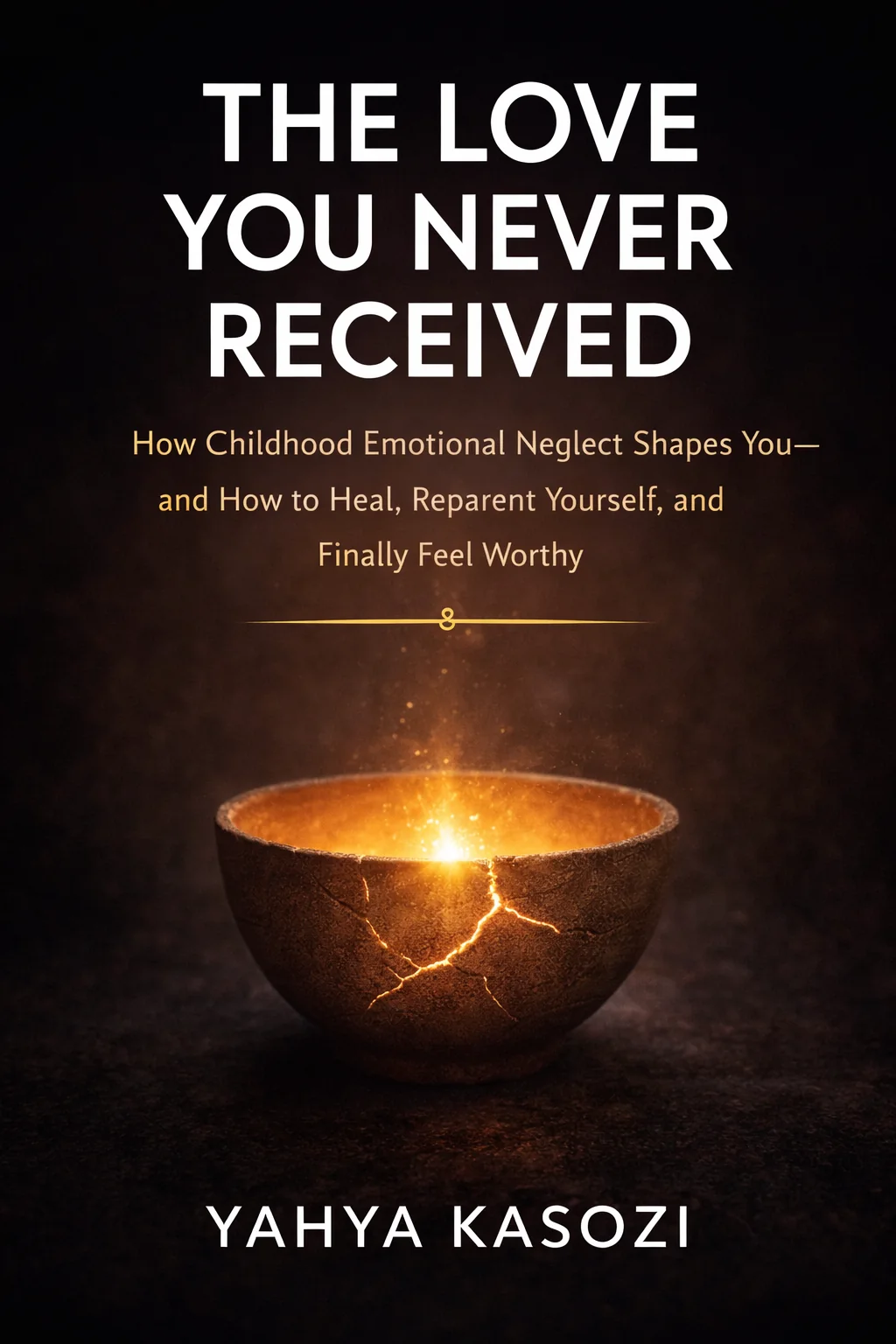
The Love You Never Received
How Childhood Emotional Neglect Shapes You—and How to Heal, Reparent Yourself, and Finally Feel Worthy
Yahya Kasozi
© 2025 by Yahya Kasozi
All rights reserved.
No part of this book may be reproduced, distributed, or transmitted in any form or by any means — including photocopying, recording, or other electronic or mechanical methods — without the prior written permission of the author, except in the case of brief quotations used for reviews, academic work, or permitted under international copyright law.
Email: [email protected]
ISBN: 978-9913-08-381-2
This book is not intended to replace professional mental health support. It provides general emotional guidance based on lived human experience and psychological insight. For medical or psychological concerns, please consult a licensed professional.
All characters, stories, or examples used for illustration are either fictional or used with permission. Any resemblance to actual persons is coincidental.
Scope and Intent
This book does not offer therapy or diagnosis. It offers structured reflection, emotional literacy, and insight drawn from widely observed human patterns. Its purpose is to help readers understand emotional patterns shaped by early experiences and approach healing with greater awareness and self-compassion.
Dedication
For the child you once were,
And the adult you are becoming.
May you always choose healing over hurt,
peace over fear,
And yourself over abandonment.
A Note to the Reader
Dear Reader,
Before you begin this journey, I want to tell you something you may not have heard often enough:
You are not difficult to love.
You are not too much.
You are not broken beyond repair.
You are a human being who grew up without the emotional nourishment you deserved — and you survived anyway.
This book is not here to shame your past, criticize your coping, or judge your wounds. It is here to offer clarity, compassion, and hope. You are understood here. You are not alone here.
Let’s walk this healing path gently — together.
— Yahya Kasozi
INTRODUCTION
When Love Was Missing, You Learned to Survive Instead of Live
For some, it was the obvious kind of absence — parents who were cold, distant, distracted, or wrapped in their own storms.
For others, it was more subtle — a childhood where needs were met but feelings were not, where your successes were noticed but your sadness was ignored, where you did everything “right” yet never felt seen.
This book is for the adults carrying the weight of that silent ache.
You may not have the language for it.
But you feel it in how you trust, how you love, how you react, and how you see yourself.
You feel it in the moments when you:
struggle to believe you’re worthy of affection
minimize your needs to avoid burdening anyone
fear disappointing the people you care about
overthink simple situations
disconnect when someone gets too close
work hard so people don’t abandon you
doubt compliments but absorb criticism
assume you are the problem, even when you’re not
This book is not here to shame your past.
It is here to explain it — and then help you move beyond it.
This book is designed to help you understand how your early emotional environment shaped your adult patterns — and how to begin changing them with clarity, compassion, and agency.
Because the truth many adults don’t realize is this:
**If you grew up unloved, you didn’t just lack affection.**
And survival is useful — but it is exhausting to carry into adulthood.
What once protected you is no longer what you need.
The way you learned to protect yourself as a child became the way you live as an adult:
hyper-independence became your armor
silence became your safety
perfection became your permission to exist
overthinking became your way of staying one step ahead
emotional numbness became your shield
expecting little became your way to avoid hurt
This book will help you understand these patterns deeply and without judgment — and then help you rebuild.
You Are Not Broken — You Are Unfinished
One of the most painful side effects of growing up unloved is the belief that something is wrong with you.
You think:
“Maybe I was never enough.”
“Maybe love is not for people like me.”
“Maybe I attract the wrong relationships because I’m defective.”
You are not defective.
Your emotional patterns did not appear randomly.
They formed in response to what was missing — not because of who you are.
This book is about enriching the soil of your inner world — the place where your self-worth, trust, confidence, and emotional life take root.
This Book Will Walk With You — Not Talk Down to You
Healing from an unloved childhood requires:
gentleness
honesty
compassion
clarity
structure
emotional safety
You will notice that this book speaks to you as someone intelligent, worthy, and capable — because you are.
There will be no pity here.
No clinical coldness.
No sugarcoating.
Just truth, delivered with care.
This book will help you:
understand your emotional patterns
identify the wounds you carry
see how childhood shaped your relationships
rebuild your inner child with kindness
develop real self-worth
break unhealthy cycles
choose better relationships
trust again without fear
move from survival to stability
This is not a quick-fix book.
It is a deep, steady companion.
You Will See Yourself More Clearly — and That Is Where Healing Begins
As you read, you will find moments that feel like someone has finally described what you could never explain.
As you read, certain ideas may feel immediately familiar.
That recognition is not coincidence — it is clarity.
Healing does not begin with solutions — it begins with recognition.
When you recognize:
why you overthink
why you fear abandonment
why criticism destroys you
why affection feels suspicious
why you minimize your needs
why you choose emotionally distant partners
why you don’t feel “good enough”
—you can finally stop blaming yourself and start understanding yourself.
Understanding is the doorway to transformation.
You Will Heal — But You Won’t Heal Alone
You were wounded in a relationship.
You will also heal in a relationship.
Not necessarily with others first,
But with yourself.
This book will guide you through:
meeting the part of you that was never loved
giving that part of you the compassion it deserved
learning emotional language
setting boundaries without guilt
rebuilding trust slowly
loving without losing yourself
making peace with the past
creating a future where you feel chosen
You will not rush through this book.
You will absorb it, reflect on it, and grow with it.
Some chapters may challenge you.
Some may comfort you.
All of them will move you forward.
This Is Not Just a Book — It Is a Turning Point
There is a moment in every healing journey where the past stops feeling like a prison, and starts feeling like a story that shaped you — but no longer controls you.
This book may be that moment.
Not because it magically removes your pain,
But because it gives you language, understanding, and pathways
To finally move beyond it.
You grew up unloved.
That is your past.
But you will not live unloved.
That will be your choice — and your healing.
What you are about to do is not relive your past — it is learn how to stop living from it.
Let’s begin
The Pattern This Book Will Help You Break
If you grew up unloved, your pain did not happen randomly.
It followed a pattern — one that shaped how you see yourself, how you love, and how you survive.
This book will return to this pattern again and again, because naming it is how you stop repeating it.
The Unloved Child Pattern:
Emotional Absence
Love, comfort, validation, or safety were missing or inconsistent.
Self-Blame
As a child, you assumed the absence meant something was wrong with you.
Survival Adaptations
You became quiet, strong, pleasing, perfect, independent, or emotionally numb to survive.
Adult Repetition
These adaptations followed you into adulthood — shaping your self-worth, relationships, and reactions.
Reparenting & Repair
Healing begins when you stop blaming yourself and start giving yourself what you never received.
Nothing in this book exists outside this pattern.
Every chapter will help you recognize where you are inside it — and how to move forward without shame.
You are not here to relive the past.
Why This Book Is Different
Many books talk about healing.
Few explain why your pain formed the way it did.
This book does not treat your emotions as flaws to fix.
It treats them as intelligent responses to emotional absence.
You are not “too sensitive.”
You are not reacting irrationally.
Your nervous system learned patterns before you had language.
Your mind adapted before you had choices.
Your behavior today makes sense when your childhood is understood.
This book will not ask you to override your feelings.
It will help you understand them — so they no longer control you.
Clarity comes before change.
Understanding comes before healing.
That is what we are doing here.
Chapter 1: What It Really Means to Grow Up Unloved
Understanding the Wound You Carried Without Words
This chapter helps you name what was missing in your childhood — so you can stop minimizing its impact and understand how it shaped you.
Not everyone who grew up unloved realizes it.
Some think,
“My childhood wasn’t that bad.”
Others say,
“They provided food, school, clothes — isn’t that enough?”
And many simply shrug and reply,
“I don’t remember much.”
But growing up unloved is not always about dramatic abuse or visible neglect.
Sometimes it is quiet.
Hidden.
It means your heart learned silence before it learned language.
It means your needs were small because expressing them felt dangerous or useless.
It means you grew up watching others receive the tenderness you secretly wished someone would give you.
1. Love is not measured by physical provision
Emotional love is not food.
It is not financial support.
It is not discipline.
It is not “doing what parents are supposed to do.”
Emotional love is:
being spoken to with warmth
being comforted when sad
having a voice that matters
being held, encouraged, and celebrated
being safe to express emotion
being accepted, not compared
being treated as a human, not a burden
Children who get everything except emotional love often become adults who:
feel unworthy
fear abandonment
overthink
hide their emotions
apologize for existing
struggle with intimacy
never feel “good enough.”
These outcomes are not character flaws.
They are the long-term effects of emotional absence during development.
2. Emotional neglect is invisible but devastating
Physical abuse is visible.
Emotional neglect is not.
And because it is not visible, people often underestimate it.
Even you might underestimate it.
But emotional neglect — a childhood where affection was missing, validation was missing, presence was missing — creates deep internal complications:
you learned to handle pain alone
you learned not to expect comfort
you learned to swallow feelings
you learned to stay quiet to stay safe
you learned to become “strong” because no one supported you
These adaptations were necessary then — but they are no longer neutral now.
The child who had no one becomes the adult who feels they need no one — even though their heart aches for connection.
3. Growing up unloved shapes your emotional identity
If you were ignored — you learned you were irrelevant.
If you were criticized — you learned you were not enough.
If you were controlled — you learned your voice was dangerous.
If you were compared — you learned love must be earned.
If you were shamed — you learned your emotions were wrong.
If you were only praised for performance — you learned your worth was conditional.
These childhood lessons later appear as adult patterns:
you feel guilty asking for help
you feel uncomfortable receiving love
you fear being a burden
you expect rejection
you struggle to trust kind people
you stay longer than you should with harmful people
4. Feeling unloved doesn’t always mean your parents were bad
This is difficult for many adults to understand.
You can grow up unloved even if:
your parents were hardworking
they provided materially
they believed they were doing their best
they followed the cultural norms they were raised with
Emotional love is a skill — and not everyone was taught how to give it.
Some parents never received emotional love themselves.
Some were overwhelmed by their own trauma.
Some didn’t know how to parent emotionally.
Some mistook criticism for “discipline.”
Some thought silence meant strength.
5. You learned to survive by shrinking yourself
When children don’t feel loved, they adjust.
They make themselves “easier” to keep the peace.
You may have learned to:
stay quiet
stay small
stay out of the way
make no demands
show no weakness
suppress your needs
And now, as an adult:
you minimize your emotions
you pretend you’re fine even when you’re not
you keep your pain to yourself
you don’t want to be “too much”
you feel guilty expressing needs
you fear losing people if you show your true feelings
But you are no longer in that environment — and now it is time to grow beyond survival.
6. The truth you were never told
Here’s the truth that will guide this entire book:
**You were unloved because the people responsible for loving you lacked the capacity to do so consistently.**
Children tend to personalize everything.
Adults take things as information.
This book will help you transition from the child’s interpretation to the adult’s understanding.
Chapter by chapter, we are taking that blame away from your shoulders.
7. You are allowed to name what happened
Naming the wound is not disrespect.
It is not ingratitude.
It is not betrayal.
It is not a weakness.
Naming the wound allows accurate understanding.
You are allowed to say:
“I didn’t get the love I needed.”
“I never felt safe expressing emotion.”
“I felt alone even when people were around.”
“I grew up feeling like a burden.”
“I learned to hold everything inside.”
This is not about blaming your past.
It is about freeing your future.
8. Your childhood shaped you — but it does NOT decide your destiny
The patterns you developed were survival tools.
But survival is not living.
You are now entering a new chapter of your life — one where:
you understand your inner child
you heal wounds you never acknowledged
you build self-worth from scratch
you set boundaries without guilt
you choose healthier relationships
you stop settling for emotional scraps
you learn to trust without fear
Awareness does not change the past.
It changes what the past is allowed to control.
From this point forward, understanding replaces confusion.
Reflection Questions
1. When you look back at your childhood, what emotional experiences were missing rather than harmful — comfort, affection, validation, attention, safety, or being understood?
2. Which childhood belief still affects you today:
“I’m too much,”
“My needs are inconvenient,”
“I shouldn’t ask,”
“I must stay quiet,”
Or “I have to earn love”?
3. What were the moments — big or small — where you realized you had to handle your emotions alone, even though you were still a child?
4. How did your caregivers respond to your emotions (sadness, anger, fear, joy)?
What message did their reactions teach you about expressing feelings?
5. In adulthood, how do the patterns of being ignored, criticized, or compared show up now — in your relationships, self-worth, or decisions?
Journaling Prompt
Write about the moment you first realized that emotional love and physical provision are not the same thing.
Describe:
what you received as a child (food, school, clothing),
what you didn’t receive (warmth, affection, safety, emotional attention),
how this shaped your understanding of love,
and what your adult self now understands that your childhood self could not.
This helps separate survival interpretation from adult awareness.
Action Step
Choose ONE way to stop shrinking yourself today, even in a small, quiet way:
express one emotion instead of hiding it
share one honest feeling with someone safe
say what you prefer without apologizing
let yourself rest without guilt
speak up instead of staying silent
allow yourself to take up emotional space
Choose one small moment today where you would normally stay quiet, minimize yourself, or dismiss your needs.
Do not explain.
Do not apologize.
Simply act differently once.
That single deviation is evidence that survival is no longer your only option.
What you are beginning to see is not just your pain — but your pattern.
These responses were not created in adulthood.
They were learned in an environment where emotional safety was uncertain.
Awareness does not heal everything immediately.
But it changes everything.
From this point forward, you are no longer confused about why you feel the way you do.
You are becoming conscious — and consciousness is the doorway out of survival.
Continue Reading
If these patterns feel familiar, you're not alone—and you're not the problem.
The Love You Never Received explores how childhood emotional neglect shapes self-worth, relationships, trust, and emotional well-being—and how healing can begin.
Continue reading: https://www.amazon.com/Love-You-Never-Received-You-ebook/dp/B0GBZ786SF
📱 Kindle Edition
📚 Paperback Edition