A free reading sample · Sibling Series · Book One
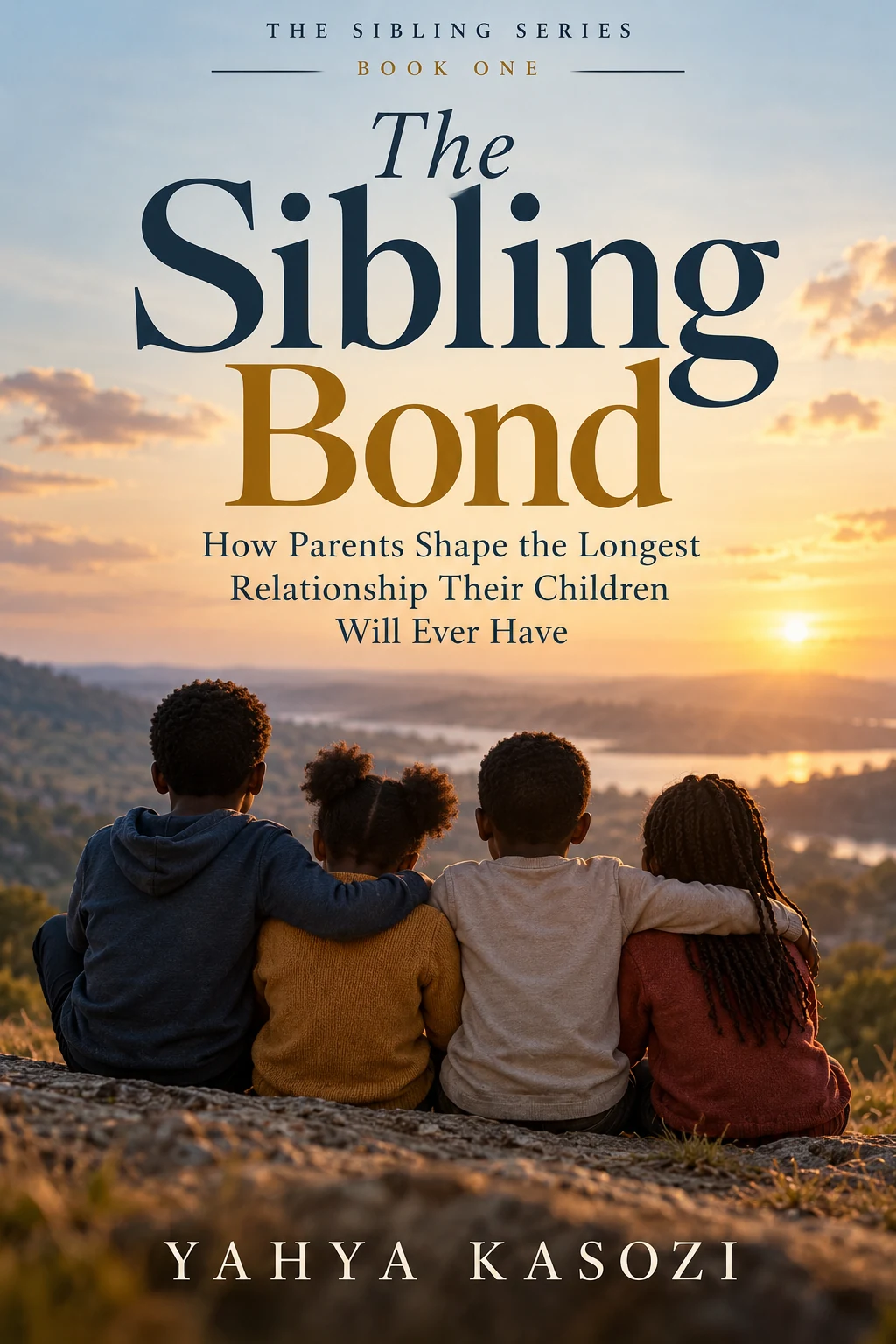
The Sibling Bond
How Parents Shape the Longest Relationship Their Children Will Ever Have
A Personal Note from the Author
I am the eldest of thirteen siblings: Enoch, Jeremiah, Moses, Elijaha, Bridget, Florence, Peter, Faith, Musa, Isma, Ahmed, Sharifa, and myself. At the time of this book's publication, I am twenty-eight years old.
You might be wondering how someone my age could have so many siblings. In some African communities, it is not unusual for a man to have multiple wives. My siblings and I have different mothers, although some of us share the same mother. I am the only child born to both my father and my mother.
Despite having different mothers, we are siblings, and I love them dearly. I think about them, make plans for them, and take a genuine interest in their lives. As the eldest, I am conscious of how each of them is doing: how they are progressing in school, whether they are healthy, what challenges they are facing and what is happening in their lives. Even though I live by myself, I keep track of them. They care about me, too. We look out for one another and support each other in whatever ways we can.
Sometimes I find myself wondering how we developed this kind of relationship. What makes siblings, despite their different personalities, circumstances and experiences, care so deeply about one another? What allows some families to remain connected even when disagreements, rivalries and other difficulties arise?
I cannot attribute the relationship I have with my siblings entirely to my own efforts. Much of what brought us to where we are today began long before I was old enough to understand it. I have never really known life without siblings around me. I grew up with them, and sometimes with cousins as well. Being surrounded by other children was simply part of my everyday experience. I did not think much about it at the time. It was just how life was.
As I grew older, I began noticing things. I observed how our parents treated us, how they interacted with one another, how they raised us and how they handled situations involving their children. I began recognising similarities between the way our parents related to us and the way we eventually learned to relate to one another. Some of what I had come to regard as natural aspects of our sibling relationships had, in one way or another, been modelled for us.
Our family is not perfect. No family is. We have had disagreements, rivalries and occasional physical altercations among some of my brothers. But those experiences have not defined us. We have continued to find our way back to one another. We love each other, care about what happens to one another and have each other's backs.
Sibling relationships are complicated. Love can coexist with jealousy. Affection can coexist with rivalry. Generosity can give way to selfishness, and loyalty can be tested by competition, misunderstandings and conflicting interests. Growing up together does not automatically mean getting along. Sharing parents, a home or childhood experiences does not guarantee that siblings will develop close relationships.
I became interested in understanding why. I looked beyond my own family and paid attention to other families in my community, particularly the relationships between siblings who had grown up together. I observed what brought them together, what drove them apart and how their relationships changed over time. Gradually, I became convinced that there was something we were not paying enough attention to: the role parents play in shaping the relationships their children eventually have with one another.
Parents influence these relationships through their decisions, behaviour, the way they treat each child, how they handle disagreements, the expectations they establish and the examples they set. Sometimes this influence is deliberate. Often it is simply part of everyday family life. Parents may not realise what their children are observing, learning and gradually adopting.
This is what led me to write The Sibling Bond. I wanted to explore how parents, through both deliberate and unintended actions, quietly shape the relationships between their children. I wanted to understand the patterns behind these relationships, how they develop, why they persist and how ordinary experiences of growing up in the same family can influence the way siblings treat one another for years, sometimes throughout their lives.
I dedicate this book to our parents, whose influence helped shape the bond between my siblings and me. I cannot say that everything they did was perfect, nor can I claim that they consciously set out to create the relationship we have today. Much of what they contributed happened through ordinary decisions, everyday interactions and patterns of behaviour that we absorbed as we grew up. For that, I am deeply grateful.
I also dedicate this book to you, the parent reading these pages. Perhaps you have wondered whether your children will remain close when they grow up. Perhaps you have watched them argue, compete or struggle to understand one another. Or perhaps you simply want to give them something that will outlast the home in which they are growing up: a meaningful relationship with one another.
Your children are not just growing up alongside one another. They are also learning how to relate to one another, and you have a greater influence on that process than you might imagine. You cannot decide what their relationship will look like throughout their lives. But you are certainly part of how it begins.
Introduction
The Relationship We Rarely Stop to Notice
The Relationship We Rarely Stop to Notice
Think about an ordinary evening in a family with two children. A parent is preparing dinner. In the next room, the children are arguing over a toy. One says it belongs to them; the other refuses to give it up. Voices rise. Someone complains that it is unfair. Eventually, the argument ends. Perhaps one child apologises. Perhaps the other walks away still annoyed. Dinner is served, and the evening carries on.
Nothing about this scene seems especially important. It is the sort of thing that happens in homes every day. But while the parent is thinking about dinner, and the children are thinking about the toy, something else is happening too: the children are having another experience of one another. They are learning, in a small and ordinary way, what happens when they disagree, how much room there is for each person's feelings, and whether a disagreement can end without damaging the relationship.
No parent could be expected to remember every argument, shared meal, car ride or afternoon in the lives of their children. There are simply too many of them. Most family life passes without ceremony. Yet relationships are built from these ordinary experiences. What happens repeatedly can begin to shape what siblings expect from one another: whether they expect help or ridicule, whether they feel able to speak honestly, and whether they see one another mainly as companions, competitors, sources of frustration, or some mixture of all three.
Parents naturally think about their children one at a time. They celebrate first words and first steps, worry about school, arrange medical appointments, notice new interests and wonder what kind of adults their children will become. All of that matters. But in a family with more than one child, another part of family life is unfolding alongside it. Those children are becoming brothers and sisters. They are learning how to share a home, compete for attention, enjoy one another, disappoint one another and, sometimes, put things right.
For many people, a sibling is one of the few people who shares the earliest chapters of their life. They may remember the same house, family celebrations, relatives, neighbourhoods and difficult seasons. They may know stories about one another that no later friend or partner could know in quite the same way. But sharing a family does not mean having the same childhood. Children differ in age, temperament, needs and their relationships with their parents. They can live through the same event and carry away very different memories of it.
The family may be shared. The experience of growing up in it is never exactly the same.
There is something unusual about sibling relationships: most people do not choose the person with whom the relationship begins. Siblings arrive in one another's lives through family circumstances, often before they are old enough to understand what being a brother or sister will mean. They may become trusted companions, fierce competitors, protectors, sources of hurt, or several of these at different points in life. Some remain close. Some grow distant. Others move between closeness and separation, or decide that distance is necessary for their well-being. There is no single path that every sibling relationship must follow.
Research suggests that sibling relationships can be important settings for development. Warmth and support between siblings have been associated with positive adjustment, while persistent hostility and destructive conflict can be associated with difficulties. Perceived differences in how parents treat their children may also affect how siblings understand their place in the family. These relationships continue to change as children enter adolescence, leave home, form partnerships, become parents and face the demands of adult life. The findings describe patterns and associations, not guarantees about what will happen in any particular family (Buist et al., 2013; Feinberg et al., 2012; McHale et al., 2012).
There is a great deal involved: temperament, attachment, parenting, fairness, conflict and what happens after conflict. Siblings influence one another, but their relationship is also affected by culture, circumstances outside the home and the choices they make as they grow older. That is why a few parenting techniques cannot guarantee a particular result. The relationship is too human, and too changeable, for that (Brody et al., 1994; McHale et al., 2012).
So what should a parent reasonably hope to do? The question is not simply, How can I make my children close? Closeness cannot be ordered into existence. Affection cannot be manufactured, and disagreement cannot be removed from family life. Parents cannot decide whether their adult children will remain friends, live near one another or remember childhood in the same way. Even children raised under one roof may eventually tell very different stories about what growing up together was like.
Recognising those limits does not make a parent's role less important. It helps us see that role more clearly. Parents influence the conditions in which the relationship develops. The siblings themselves will shape the relationship within those conditions.
Parents help establish the emotional climate of a home. They influence how fairness is understood, how differences in children's needs are handled, and what happens when anger, jealousy or disappointment appears. They can model accountability, make room for each child's individuality and show that being hurt does not give anyone permission to humiliate another person. They can also recognise when conflict has crossed a line and protect a child from coercion, intimidation or repeated harm rather than dismissing it as ordinary sibling rivalry.
Children learn from what parents tell them, of course. They also learn from what they repeatedly experience and observe. If a mistake is met with humiliation, a child may learn to hide mistakes or strike back. If someone takes responsibility and makes a genuine effort to repair the harm, children get to see that disagreement does not have to end a relationship—and that an apology is more than a word. When one child needs something different from another, the way a parent explains and manages that difference can influence whether it is understood as reasonable or experienced as favouritism (Morris et al., 2007; Zinsser et al., 2021).
None of this guarantees that siblings will become close. Children have their own personalities, perceptions and agency. They may respond differently to the same parenting, resist what they are taught or build relationships their parents never expected. The purpose is not to control the outcome. It is to create conditions in which respect, trust, cooperation and repair have room to grow.
That is what this book sets out to explore. It is not a manual for producing perfect siblings, eliminating conflict or securing lifelong closeness. Nor does it place the whole responsibility for an adult relationship on parents. Instead, it looks at the ways everyday family life can influence the relationship children are building with one another, what parents can do to support that development, and where parental responsibility has its limits.
Much of this influence happens in moments that barely register as events: breakfast, chores, the journey to school, an argument over possessions, or the familiar competition for a parent's attention. It appears when one child needs more help than another, when a parent decides how to respond to a complaint, and when siblings have to work out what happens after someone has been hurt. A single moment may not seem important. What matters is that similar moments return, and that children gradually form expectations from them.
Over time, those expectations can affect how siblings approach one another. They may learn to disagree without treating each other as enemies, to recognise another person's needs without abandoning their own, and to repair harm without pretending that an apology erases it. They may also develop patterns that make closeness difficult, especially when hurt is ignored or harmful behaviour becomes normal. Parents cannot prevent every difficulty. They can, however, notice patterns and respond when a child needs protection or guidance.
The aim is not to give children a childhood without arguments, differences or disappointment. It is to give them repeated experiences of respect, fairness, cooperation, boundaries and repair. It is to help them discover that belonging to someone does not require becoming just like them.
Parents do not write the whole story of a sibling relationship. Their children will make choices, encounter circumstances and form opinions that no parent can fully anticipate. Still, the family environment becomes part of the history from which that relationship grows. Some childhood experiences remain meaningful long after the children have left home.
The early chapters matter—not because they decide the ending, but because they help establish the conditions from which the rest of the story can grow.
Chapter One
The Relationship You Will Help Shape
There are moments in parenting that stay with us. A child's first smile. The first day of school. Learning to ride a bicycle. A graduation, a wedding, or the moment a child leaves home to begin a life of their own. These milestones make the passage of time visible. They remind parents that the little person they once carried is becoming someone with a life and decisions of their own.
But most family life does not happen at milestones. It happens in between. Breakfast is being made. School bags need packing. Someone has lost a shoe. Two children are arguing about whose turn it is. There are jokes, small acts of kindness, competing demands for attention and routines that become so familiar nobody thinks to mention them. When a family has more than one child, these ordinary moments are also where another relationship is taking shape: the relationship between the children.
Parents have plenty of questions about each child. Is she doing well at school? Is he becoming responsible? Does she have good friends? Is he learning to manage his emotions? These are important questions. But there is another one I think deserves a place beside them: what are my children learning about how to live with one another?
Children who grow up together are constantly encountering one another's needs. They have to share space, negotiate competing wishes, respond to jealousy, celebrate another person's success and deal with the frustration of not always getting what they want. An older child decides whether to include a younger one in a game. One child receives praise while another feels overlooked. A brother helps his sister with homework; a sister comforts her brother after a difficult day. And sometimes neither is willing to give an inch. Parents cannot decide what every interaction will mean to a child, but these experiences give children material from which their expectations of one another can develop.
A child may gradually come to expect help from a sibling. Another may begin to anticipate ridicule, or assume that every disagreement will end in rejection. A child may learn that frustration can be expressed without destroying a relationship, that a boundary should be respected, or that an apology ought to be followed by an effort to make things right. These beliefs are not formed in a single encounter. They develop through temperament, repeated experience, changing circumstances and the responses children receive from the people around them.
This is why sibling relationships deserve our attention. Not because they determine who children will become, but because they are one of the settings in which children learn to live with other people. Siblings can give one another opportunities to practise cooperation, perspective-taking, negotiation and emotional understanding. They can also expose one another to hostility, intimidation and persistent humiliation. Being part of the same family does not automatically make a relationship safe or supportive.
And this is only the beginning.
How do ordinary family moments become lifelong expectations? What does fairness look like when children have different needs? When should parents step in, and when should they allow siblings to work things out? The book follows these questions from childhood into adulthood—without pretending parents can control the ending.
The reading sample ends here. Continue with the complete book to explore the chapters on emotional safety, fairness, conflict, family culture, repair, adulthood and the legacy parents leave behind.
Explore the bookTry the Sibling Bond ReflectionBuy the complete book on Amazon